
Words: Ken Crawford
Photos: Zach Cordner
In her first solo museum show, the Riverside artist lets strangers into her faith, her journals, and her bed. She isn't trying to shock anyone. She's trying to tell the truth.
Neveah Marquez wants to know what you hold sacred. Her own answer fills two-room gallery, upstairs at the Riverside Art Museum.
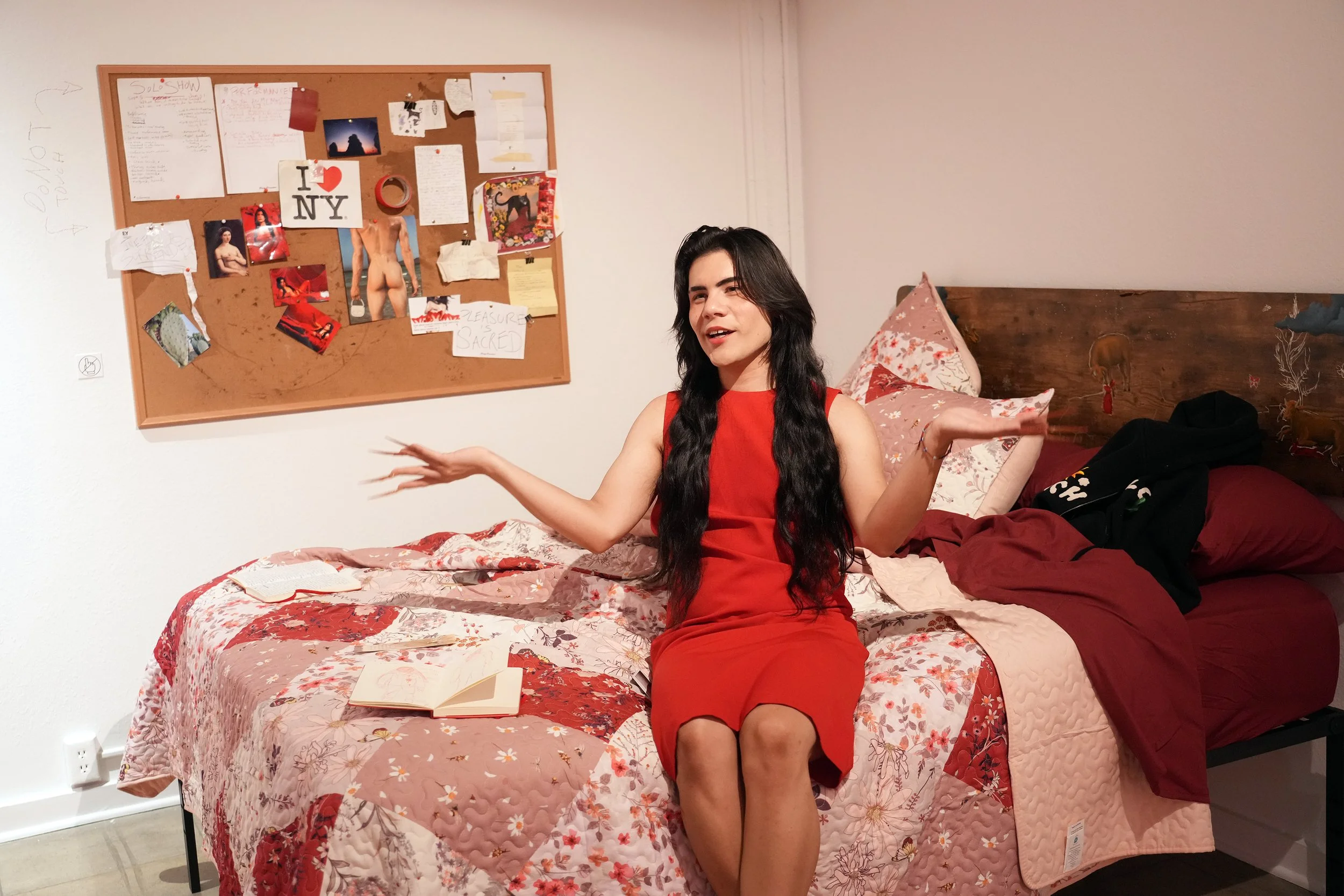
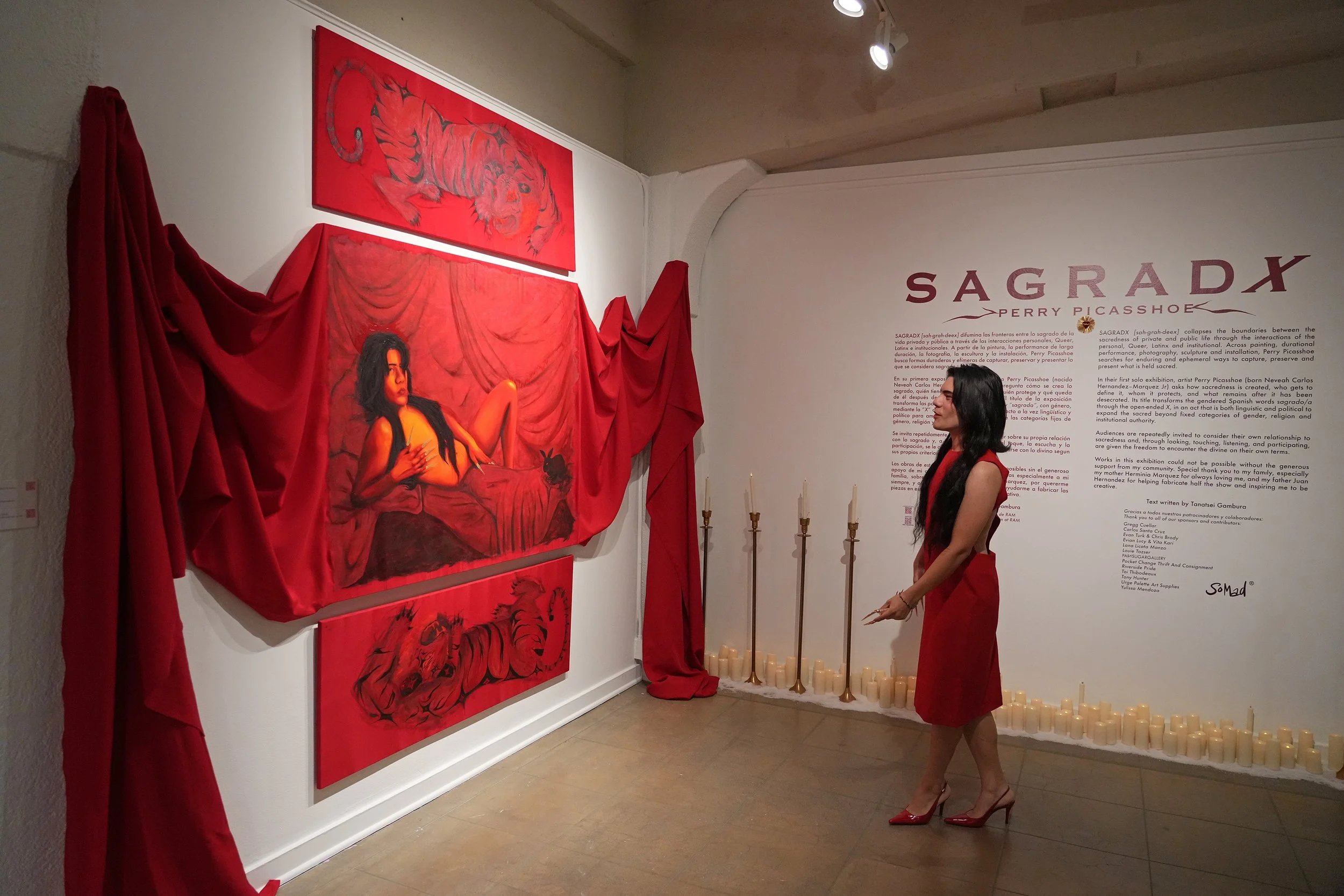
SAGRADX, her first solo museum exhibition, runs through Jan. 31 in the Powell and DeVean galleries of the museum's Julia Morgan Building. The title swaps the gendered endings of the Spanish words sagrado and sagrada for an open X. Inside, visitors see paintings, photographs, a steel cross, a wall of relics, a recording of anonymous confessions, and a bed covered in journals they are invited to read.
Marquez walked a small group through the exhibition. The story was intimate, but Neveah never flinched; she carried an expert confidence without a hint of shyness, like a seasoned docent who knew the artist. She stopped to mention that one sculpture had broken in shipping and that her father was probably fixing it. She ended by noting the museum needed more postcards. There was no performance in it. The work is personal and often raw, but it is not intended to shock. It is built to be honest.
That honesty reached her own life. Marquez came out publicly as a transgender woman in September, while the show was being installed, and the wall text still carries her old name, Perry Picasshoe. Her transition happened while she was making SAGRADX. The show was not made to announce it. She said that as she finished the last pieces, she realized a show about vulnerability required her to be honest with herself first.
Artists have long used their own lives as medium, and sometimes they have to retire a version of themselves to keep going. David Bowie invented Ziggy Stardust, rode him to fame, then killed him off onstage at London's Hammersmith Odeon on July 3, 1973. The character had started to swallow the man.
Marquez chose the name Perry Picasshoe at 14, a play on Picasso and a way to be taken seriously as an artist. She said it came about at a time when it was necessary. That chapter is closed now. The difference is direction. Bowie set down a character to get back to himself. Marquez set down a name so she could be seen as herself.
Her starting point is the church. Marquez grew up in Riverside deep inside Catholicism, and her family once expected her to become a priest. She has not walked away from that upbringing. She builds with it.
"That's what I grew up in," she said. "That's my language that I'm used to."
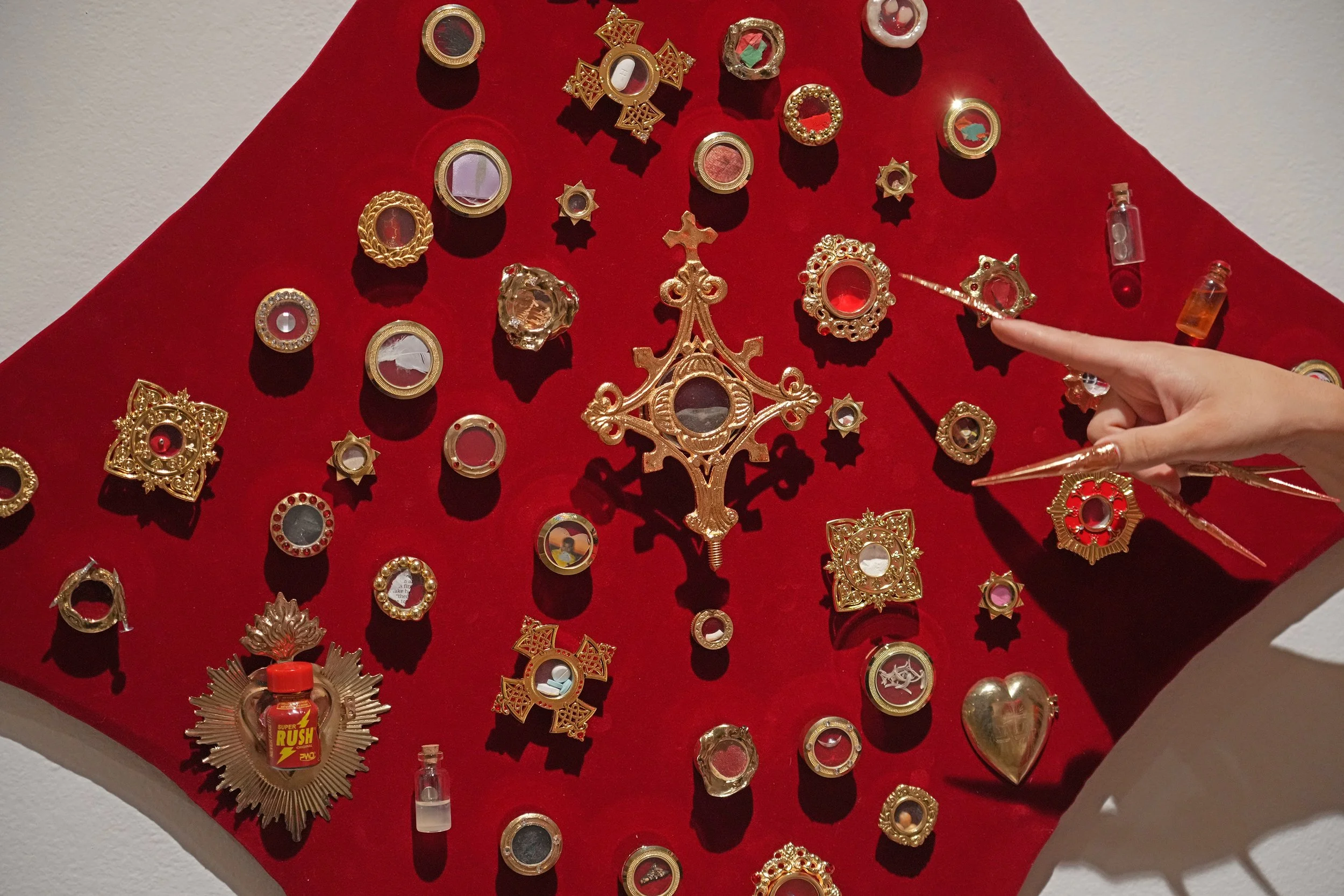
In Catholic practice, a first-class relic is part of a saint's body, such as bone or hair. A second-class relic is something the saint touched. Marquez applies the same rules to her own life. Reliquaries cover one wall. In one, she said, is the hair of her dead cat, found while she moved furniture. Others hold her blood, her pills and her eczema. One holds a balloon from the place where police shot a man in a Home Depot parking lot near the museum. She pointed out that people still buy relics online, splinters said to come from the cross. The wall asks the church's own question: what makes an object holy, and who decides?
The first room also faces outward. Since last year, Marquez and her father have set blocks of ice at places where immigration agents detained people, and photographed them. She said the hard part was showing the loss without turning suffering into spectacle.
Nearby, a recording plays. At a church, Marquez hosted a masquerade for the queer community. About 100 people came, masked in pearls, angel wings and wildflowers, for a singing duo, a drag performance and burlesque. On one side of the room, guests stepped up to a microphone and confessed. Marquez layered every confession into a single track. You hear everyone and no one.
"There's beauty in anonymity," she said. "There's safety in that."
The steel cross asks a harder question. Marquez wanted to know what her generation holds most sacred, and her answer was the phone. In a performance in New York, she was tied to the cross with her own phone strapped to her chest, unlocked. For the length of the performance, anyone could pick it up and scroll through her messages, her photos, her notes. Anyone could have wiped it. She cried the whole time and described it as terrifying. No one did anything cruel with it. To her, the exposure of the phone and the violation of a body are the same act.
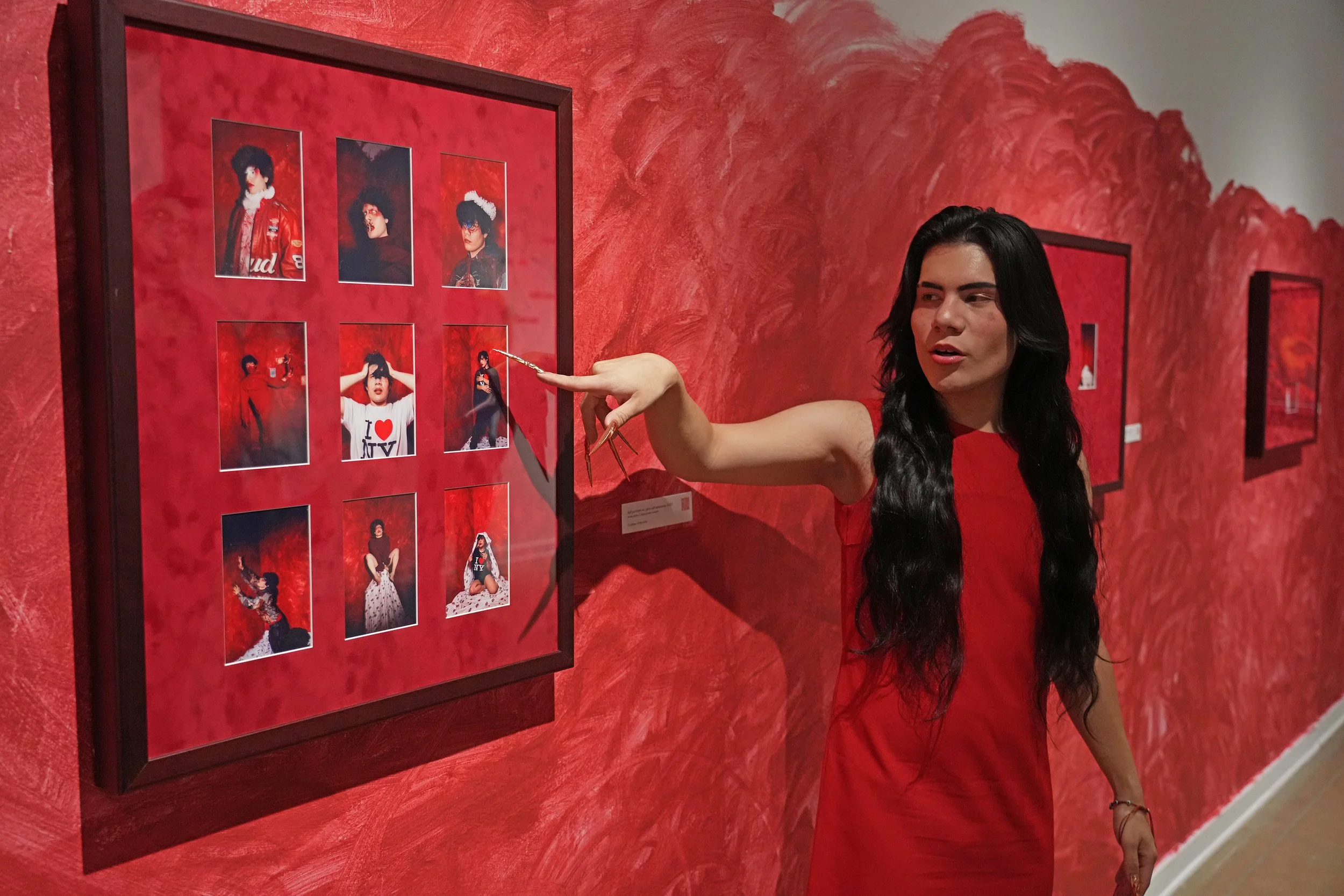
Red runs through all of it. Red means stop. It means danger. It is the color built to command attention. For Marquez, it means calm. She used it to settle herself when anxiety hit, and it kept following her until, she said, everything she does is red.
"The idea of taking up space is a huge part of my practice," she said.
The second room is a bedroom, and the show began there, with a betrayal. An ex-partner brought someone else into their bed. The hurt showed her what she held sacred, so she turned the bed into a question: if she let strangers in, would they be respectful? The journals on it hold everything behind the show, including her notes on institutions, her measurements and the exhibition's budget. Visitors can read them, write in them, even destroy them. She said that part is out of her hands.
The self-portraits in this room began in New York after a breakup, in a room painted bright red. She was heartbroken, and she was slowly getting comfortable in her body again. One photograph shows her lying in what she called an elegant, almost sleeping pose. It was among the first times she looked at herself and thought, "Oh, maybe I can be a beautiful woman."
The last piece she made for the show came this summer. On July 25 she went to Joshua Tree and took her first dose of estrogen under a Joshua tree. She came home, took a photo and painted from it.
The show closes with flowers. Marquez painted her friends in sacred moments as their favorite flowers. Across the room hangs a family portrait years in the making, everyone she loves rendered the same way, including the cat whose hair sits in the reliquary.
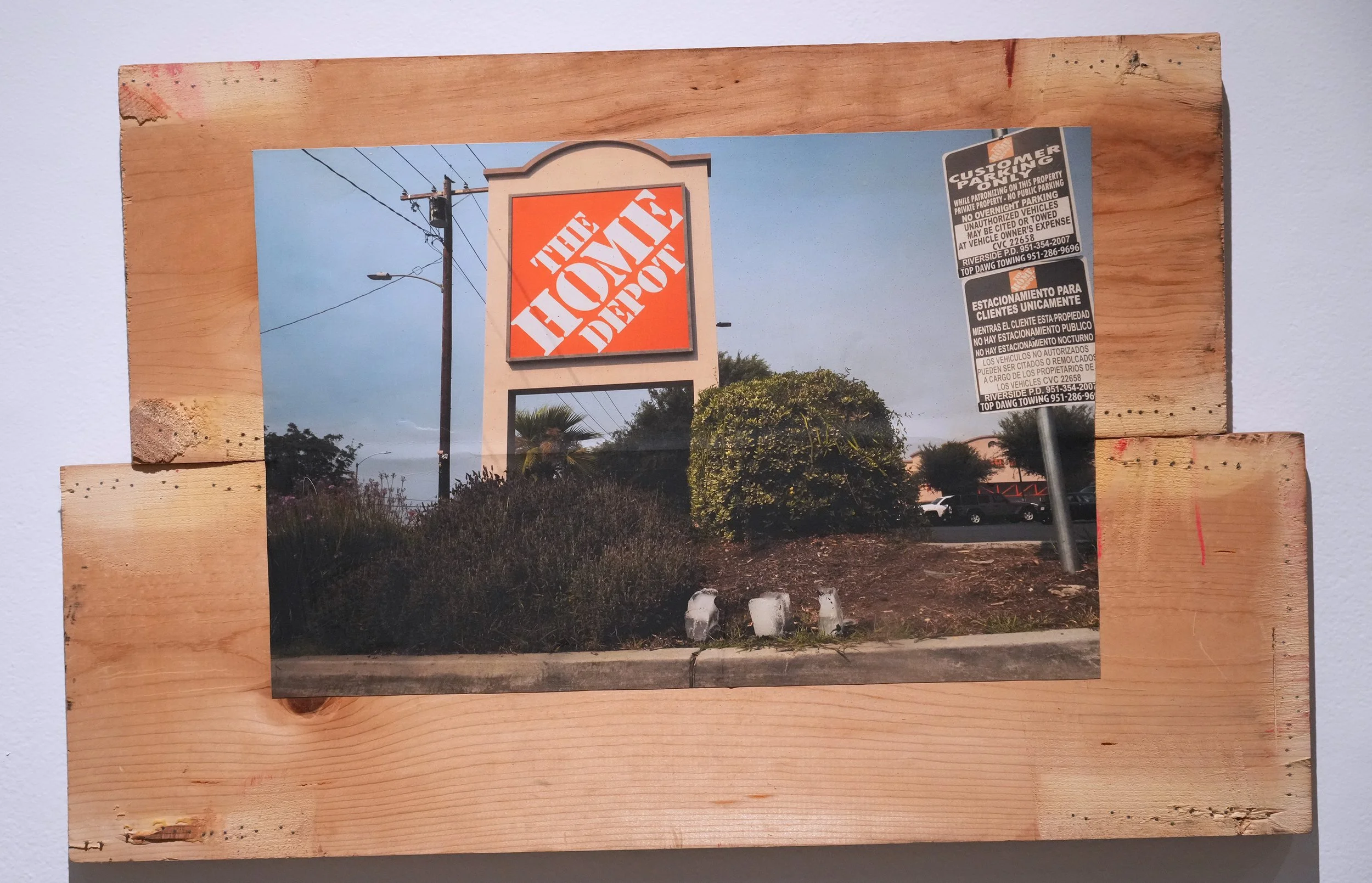
Her father is everywhere in the show, mostly unseen. Juan Hernandez built the frames and the crates that carried the cross to New York. He drove her to the sites with the ice. The wall text credits him with helping fabricate half the show. He was a DJ in the 1980s, and when she doesn't know how to build something, she said, he figures it out. Their relationship has grown stronger the more she has let him into the work.
"He's just a cool dude," she said.
The wall also thanks her mother, Herminia Marquez, for always loving her.
The wall still says Perry, and she plans to talk with the museum about changing it. Until then, SAGRADX stands as Perry's last show and Neveah's first.
SAGRADX runs through Jan. 31, 2027, at the Riverside Art Museum, 3425 Mission Inn Ave. Details at riversideartmuseum.org.
